
When it comes to game development, the tools and languages developers choose can make or break a project. While giants like C++ and Unity often dominate the conversation, Ruby, a language known for its simplicity and elegance, might not immediately come to mind. But could this underdog have untapped potential in the gaming world?
Ruby’s flexibility and readable syntax have earned it a loyal following in web development, yet its role in game creation sparks curiosity. Is it capable of handling the demands of interactive worlds and complex mechanics, or does it fall short? For developers seeking creative solutions, exploring Ruby’s possibilities in game development might just reveal some surprising advantages.
Understanding Ruby As A Programming Language
Ruby is an open-source programming language known for its simplicity and focus on developer productivity. It uses a clean and readable syntax, making it accessible to both beginners and experienced developers.
Key Features Of Ruby
- Object-Oriented Design
Everything in Ruby is an object, including numbers and strings. This consistent object-oriented approach simplifies complex programming tasks.
- Dynamic Typing
Ruby is dynamically typed, meaning variable types are determined at runtime. This allows developers to write flexible and concise code.
- Garbage Collection
Ruby includes automatic memory management through garbage collection, reducing the need for manual memory allocation.
- Readable Syntax
Ruby’s syntax mirrors natural language, ensuring code remains clean and understandable.
- Rich Library Support
Ruby offers a vast standard library, covering various tasks like file handling and networking, along with gems for extended functionality.
Advantages Of Using Ruby
- Faster Development
Ruby accelerates development with its concise syntax and pre-built libraries. This efficiency suits smaller-scale gaming projects or prototypes.
- Community Support
Ruby developers benefit from active community contributions, frequent updates, and detailed documentation.
- Platform Independence
Ruby operates on multiple platforms, ensuring versatility in crafting games for different operating systems.
- Ease of Learning
Ruby’s beginner-friendly nature helps new developers quickly learn and start building applications, including games.
- Web Integration
Ruby has strong web development capabilities, making it an asset for online multiplayer games requiring server-side functionality.
Game Development With Ruby

Ruby’s flexibility and ease of use attract some developers to explore game development with it. While not a mainstream choice, its dynamic capabilities and user-driven libraries provide unique opportunities.
Popular Ruby Tools And Libraries For Game Development
- Gosu: Gosu is a 2D game development library for Ruby. It supports multiple platforms, offers tools for graphics, audio, and input, and is suited for simpler 2D games.
- Rubygame: Rubygame, based on SDL, enables game creation with Ruby. It includes features for animations, events, and input handling.
- Chingu: Built on Gosu, Chingu adds abstraction layers, easing the development of sprites, states, and collisions.
- RPG Maker: RPG Maker uses Ruby for scripting, allowing customization of RPG elements like maps, battles, and characters.
- DragonRuby: A lightweight Ruby-based game engine that supports 2D games and runs on multiple platforms, including mobile devices.
Challenges Of Using Ruby For Game Development
- Performance Limitations: Ruby’s interpreter is slower than compiled languages like C++, which can hinder high-performance game requirements.
- Limited Documentation: Ruby’s game development resources and tutorials are fewer compared to C# or JavaScript.
- Smaller Ecosystem: Ruby has fewer game-specific libraries, reducing options for advanced or 3D projects.
- Scalability Issues: Ruby faces difficulties in managing large-scale, graphically intensive games.
- Tool Integration: Ruby’s compatibility with major game engines is lower, limiting its adoption in professional game development contexts.
Comparing Ruby To Other Game Development Languages
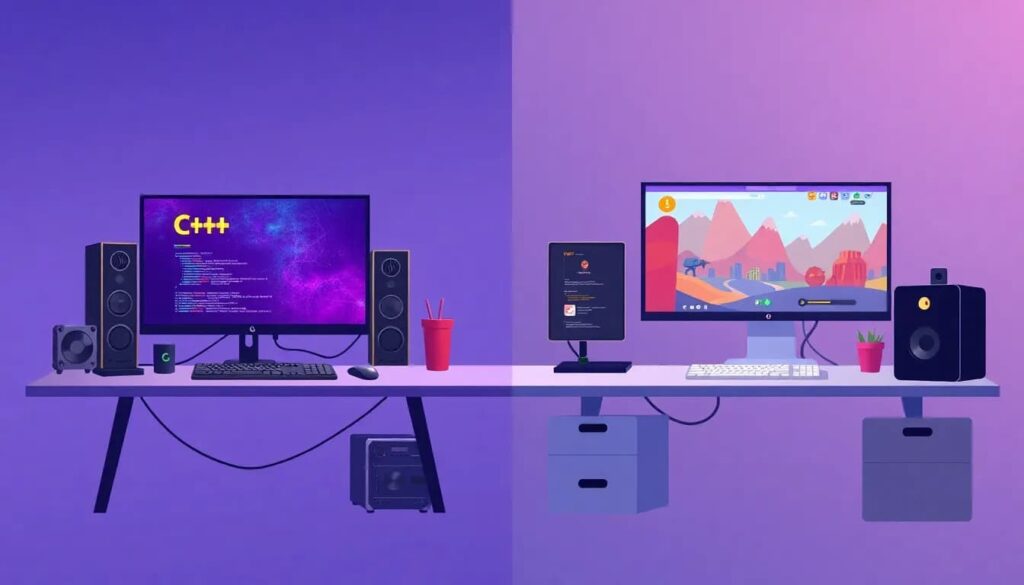
Ruby’s application in game development often invites comparisons with other programming languages, especially in terms of performance, ecosystem, and developer experience.
Ruby Vs. C++ For Game Development
C++ excels in game development due to its high performance and low-level memory management. Developers use it to build large, graphics-intensive games requiring real-time processing and optimization. It integrates with major game engines such as Unreal Engine and Unity, offering extensive tools and plugins for game mechanics, physics, and rendering.
Ruby, in contrast, prioritizes simplicity and developer productivity over execution speed. Its interpreted nature makes it slower than C++, which may affect the performance of CPU-intensive games. Ruby best suits smaller games or prototypes where rapid development matters more than runtime efficiency. Though Ruby lacks integration with major engines, libraries like Gosu and DragonRuby fill niche requirements in 2D game development.
Ruby Vs. Python For Game Development
Python and Ruby share similarities, including an emphasis on readability and ease of use. Python has a broader game development community, supported by libraries like Pygame for 2D games and Panda3D for 3D development. Its performance also slightly surpasses Ruby due to optimizations in tools like PyPy.
Ruby offers a smaller but focused ecosystem, often shining in games requiring advanced customizations or web-based multiplayer features. But, Python’s extensive documentation, resources, and adoption in tools like Godot Engine provide an edge for developers tackling more complex or scalable projects. Ruby’s suitability remains confined to specific scenarios, while Python serves diverse game genres effectively.
Use Cases Of Ruby In Game Development

Ruby plays a unique role in game development, offering tools and libraries that support smaller, creative projects. Developers often use it for prototyping or games with simpler mechanics.
Notable Games Built With Ruby
Some games built using Ruby or Ruby-based tools demonstrate its capabilities. “Diamond Trust of London” is a strategy game using DragonRuby. “Osu!Stream”, a rhythm game, utilizes Ruby for web-related functionalities. These examples highlight Ruby’s ability to handle distinct gameplay elements, like strategy and rhythm synchronization, even though its rare use in game development.
Ruby’s Role In Indie Game Development
Indie developers leverage Ruby for its simplicity and flexibility. Libraries like Gosu and Chingu help create 2D games quickly. Ruby’s readable syntax reduces the development learning curve, making it suitable for small teams or solo developers. The availability of DragonRuby Game Toolkit provides cross-platform support, allowing games to run on desktops, consoles, and mobile devices. Ruby’s use by indie developers often focuses on artistic and experimental projects rather than performance-heavy or 3D games.
Conclusion
Ruby may not be the first choice for game development, but it offers unique advantages for certain scenarios. Its simplicity, flexibility, and strong community support make it appealing for smaller-scale projects, prototypes, and indie games. While it faces challenges with performance and scalability, tools like Gosu and DragonRuby provide valuable resources for developers exploring creative and experimental game design.
For those willing to embrace its strengths and navigate its limitations, Ruby can serve as a powerful tool in crafting innovative gaming experiences.